YouTube doubled its monetization threshold. Indie filmmakers may feel it most
Starting February 1, 2027, new YouTube creators will need twice as many watch hours or Shorts views to qualify for ad and Premium revenue. The higher bar may hit independent filmmakers especially hard because films take longer to make, release, and build an audience around.
YouTube doubled its monetization threshold. Indie filmmakers may feel it most
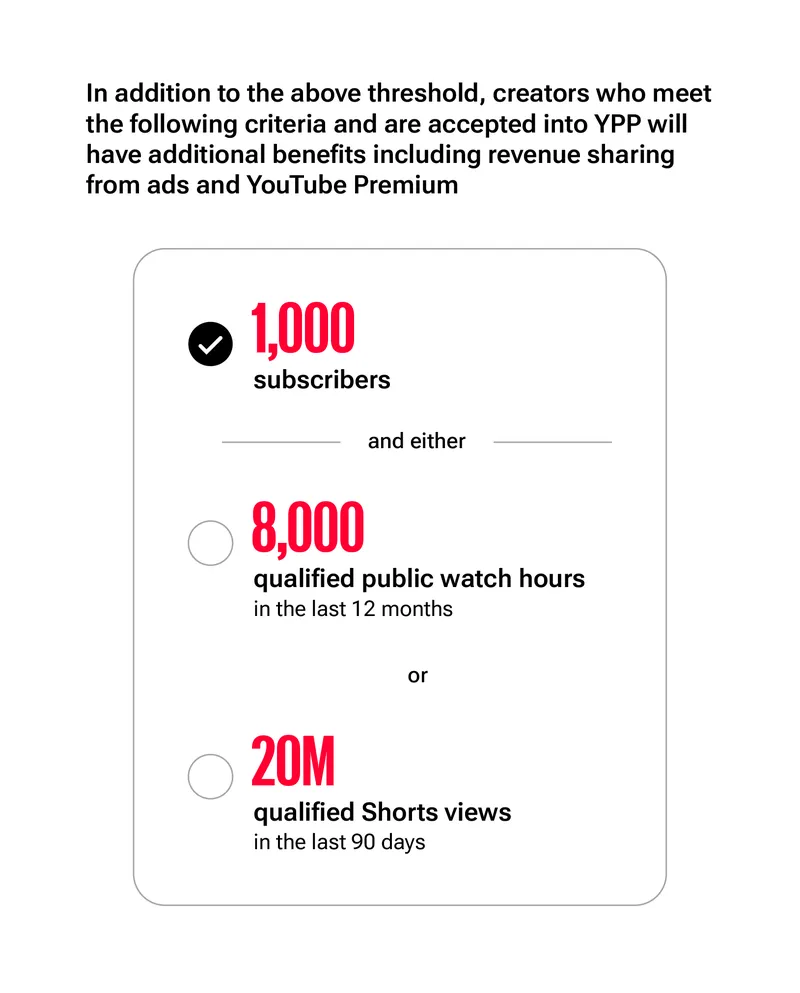
Starting February 1, 2027, a new YouTube channel will need 1,000 subscribers and either 8,000 qualified watch hours within 365 days or 20 million qualified Shorts views within 90 days to qualify for ad and YouTube Premium revenue.
That is double the current requirement of 4,000 watch hours or 10 million Shorts views.
YouTube says the change will help the company keep pace with platform growth and invest in new earning programs. For an independent filmmaker, though, the message is harder to ignore that now, before your film can earn a share of advertising or Premium revenue, you may first need to create the kind of viewing volume that many films are uploaded to YouTube to find.
That creates a difficult loop. You need an audience to qualify for monetization, but monetization is supposed to help you afford the work required to build that audience.
What YouTube is changing in 2027
YouTube announced the changes on August 10, 2026. The new rules affect entry into the higher YouTube Partner Program tier that shares revenue from ads and YouTube Premium.
The lower entry point for fan funding and Shopping is not changing. In eligible regions, creators can still apply for that tier with 500 subscribers, three public uploads within 90 days, and either 3,000 qualified watch hours within a year or 3 million qualified Shorts views within 90 days. Reaching that level does not unlock ad or Premium revenue sharing.
Creators already in the higher YouTube Partner Program will not have to meet the new 8,000-hour or 20-million-view entry threshold again. However, YouTube is adding activity requirements. A channel will be considered active if it reaches at least one of these measures:
1,000 qualified watch hours within the previous 365 days
1 million qualified Shorts views within the previous 90 days
Two long-form uploads or five Shorts within every 90-day period
YouTube says channels that fall below all three will receive a 90-day period to restore their activity. Existing partners must also accept the updated terms in YouTube Studio by January 31, 2027 to continue earning from the related features.
Why filmmakers are not ordinary video creators
A YouTube creator might record, edit, and publish a video within a day or a week. An independent filmmaker may spend months or years writing, financing, casting, shooting, editing, clearing rights, and submitting one film to festivals.
The new threshold does not account for that difference.
Eight thousand hours equals 480,000 minutes of viewing. If every viewer watched a 10-minute short from beginning to end, the film would need 48,000 complete views to reach the watch-time requirement. If the average viewer watched five minutes, it would need 96,000 views. The channel would still need 1,000 subscribers and approval after YouTube reviewed it.
Trailers, clips, director diaries, and behind-the-scenes videos can help, but they require another production plan. A filmmaker who already spent two years finishing a film may now have to become a high-frequency channel operator before the film earns its first dollar from YouTube ads.
That is a different job.
The new activity rules create another mismatch
YouTube says its updated program is designed to reward active creators. That sounds reasonable until activity is measured against the production schedule of a film.
A filmmaker can stay active without uploading every 90 days if older videos continue producing at least 1,000 qualified watch hours per year. If those views slow down, the channel may need to publish two long-form videos or five Shorts every three months.
That can pressure filmmakers to release extra material because the platform expects activity, not because the material helps the film or its audience. Some filmmakers will turn interviews, production diaries, deleted scenes, festival updates, or educational videos into a useful channel. Others may not have the time, rights, footage, or interest.
The same tension is even sharper for Shorts. Ten million qualified Shorts views within a rolling 90-day period will be required to earn from the Shorts Creator Pool each month. A filmmaker can remain in the program and keep earning from long-form videos if the channel falls below that number, but Shorts revenue will pause until the channel crosses the threshold again.
For many independent filmmakers, Shorts may remain a promotional tool rather than a dependable income source.
Is AI-generated video the reason for the change?
YouTube has not said that AI-generated video caused the new thresholds.
Its official announcement points to the growth of YouTube, more than 200 billion daily Shorts views, and the company's plan to invest in other creator incentives. It does not identify AI saturation or the lack of film curation as the reason.
Still, the concern is understandable.
YouTube has already tightened how it describes content that can earn money. In July 2025, the company renamed its policy for repetitious content to "inauthentic content" and clarified that repetitive or mass-produced videos were not eligible for monetization. Its current policy specifically lists generic, templated AI-generated videos that appear mass-produced as content that cannot earn through the Partner Program.
There is also evidence that low-quality AI video has become visible in the viewing experience. A 2025 Kapwing test, reported by The Guardian, classified 104 of the first 500 Shorts shown to one new account as AI-generated. That was a limited test of one account, not a measurement of all YouTube viewing. It still illustrates how quickly cheap, high-volume video can fill a feed.
Fylm TV's view is that AI saturation is part of the larger pressure behind stricter quality and monetization controls, even if YouTube has not named it as the reason for this specific threshold increase.
The problem is that doubling the threshold is a blunt response. It does not distinguish between a filmmaker who spent two years making an original short and a channel that publishes dozens of low-cost videos every week. Both must reach the same numbers. A high-volume channel may even be better built to do it.
A higher threshold does not solve the curation problem
YouTube reviews channels for policy compliance. It does not select independent films for their storytelling, technical quality, genre, audience fit, or potential as film projects.
That distinction matters.
A popularity threshold measures how much viewing a channel has already produced. It does not tell a viewer whether a film is worth watching. It does not help a strong first-time filmmaker reach people who actively want independent drama, horror, documentary, animation, or experimental work.
Open platforms are useful because almost anyone can upload. That same openness creates noise. When the cost of producing video falls, the amount of video can grow faster than the amount of human attention available to watch it.
Raising the gate for revenue does not reduce that noise for viewers. It mainly delays when smaller channels can be paid.
What independent filmmakers should do now
YouTube can still be useful. It can host a full film, trailer, proof of concept, production diary, filmmaker commentary, or a series of clips that introduce the project to new viewers. The mistake is treating YouTube ad revenue as the entire distribution and monetization plan.
Before uploading a film, decide what the release is supposed to accomplish. Then build a plan that does not depend on one platform's rules staying the same.
Check festival, distributor, music, performer, archival, and territorial restrictions before publishing the full film.
Build an email list or another direct way to reach viewers outside YouTube.
Use trailers, scenes, interviews, and behind-the-scenes material only when they support the film and fit your available time.
Track watch time, completion, traffic sources, repeat viewing, press, screening requests, and audience actions. A view count alone tells an incomplete story.
Consider revenue beyond ads, including paid screenings, sponsorships, licensing, crowdfunding, merchandise, donations, educational use, and direct fan support.
Keep copies of your analytics, audience contacts, and release materials. Platform policies can change after your film is published.
Compare open-upload platforms with curated film services that review work and attract viewers specifically interested in independent cinema.
What this could mean over the next decade
As AI makes basic video production faster and cheaper, the internet will not suffer from a shortage of content. It will suffer from a shortage of attention and trust.
Large open platforms may respond by raising revenue thresholds, adding more automated review, and rewarding channels that publish consistently. That approach can reduce some abuse, but it can also make slow, expensive forms such as independent film harder to sustain.
The counterweight will be curation. Viewers will need trusted places that narrow the choices. Filmmakers will need distribution partners that understand the difference between a film release and a daily content schedule. They will also need audience relationships and performance data they can carry into crowdfunding, licensing, sponsorship, and acquisition conversations.
Fylm TV is currently building a curated platform for independent films, with submissions reviewed for quality and fit. The platform is still pre-launch, and several monetization tools are planned to roll out in stages. Filmmakers can submit a film for consideration while continuing to use YouTube as one part of a broader release strategy.
YouTube's new policy is a reminder that access to an audience and access to revenue are not the same thing. Independent filmmakers need both, and they should not have to become content factories to earn them.